


Kyiv / Berlin, 7 September 2026 — Ukraine’s adult industry is closer to a legal reset than at any point since independence. After two failed attempts, parliament has adopted draft law No. 15294 in the first reading. Consensual adult content would leave the criminal code. Child sexual abuse material, non-consensual imagery and coercion would be punished more severely. A second reading is still required. A Wall Street Journal report this weekend has pushed the tax-and-drones argument back to the top of the agenda.
For studios, platforms and agencies working out of Berlin, this is not a regional side note. Ukraine is one of the most productive source countries for creators on international platforms. Anyone who books talent, pays out earnings or buys traffic from the region has a direct interest in how this file ends.
Third attempt, different title, thin majority
The bill is officially titled “On Amendments to the Criminal Code of Ukraine to Strengthen Liability for the Production and Distribution of Child Pornography.” The name is the political strategy. Its predecessor, draft No. 12191, failed on 28 May 2026 with 207 votes — 19 short of the 226 required. The new text was registered on 3 June 2026 and signed by 45 MPs from almost every faction, including parliamentary and committee leaders.
On 14 July 2026 it cleared the first reading 231–8, with three abstentions. Fifty-five deputies did not vote. That is better than May. It is not a safe majority. Finance Committee chair Danylo Hetmantsev called the result a victory of “common sense over obvious absurdity,” then warned that the margin is not strong enough to guarantee the final vote.
Opposition MP Yaroslav Zhelezniak (Holos) remains the political engine. He has driven the file since 2023, after a 2022 draft prepared by policy expert Ihor Samokhodskyi and a coalition of NGOs stalled inside government. Zhelezniak’s line after the May defeat was blunt: take this “feeding trough” away from law enforcement.
Decriminalisation is not legalisation
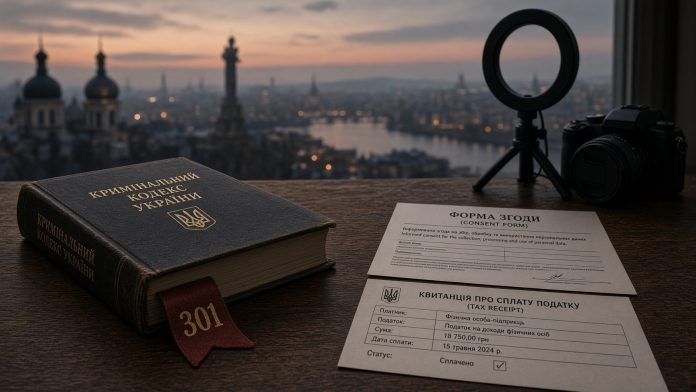
The distinction matters for every headline and every compliance memo. 15294 does not create a licensed market, a studio regulator or a German-style industrial code. It removes criminal penalties for specific acts involving consenting adults. Article 301 of the Criminal Code stays. Its scope is redrawn.
Under current law, producing, distributing, sending, selling and in some cases storing pornographic material can bring fines, probation or prison. Public debate cites three to five years, and in some configurations up to seven. Because the statute does not cleanly separate pornography from erotica, even private nude photos exchanged between adults — or stored on a personal phone — can fall under 301.
Prosecutors opened about 1,500 adult-pornography cases in the first nine months of 2025, up 13 percent year on year. Across 2025 the count exceeded 1,400, the highest in four years. A large share involved consensual adult content.
If 15294 becomes law in the form adopted as a base text, the main changes would be:
- Production, import, storage, transport, sale and distribution of consensual adult material among adults would no longer be a crime.
- Supplying pornography to minors would remain criminal: fines or up to five years; three to seven years where young children are the audience.
- Distribution without the depicted person’s consent (revenge porn, non-consensual deepfakes) would stay criminal.
- Forcing an adult to take part in pornographic production: three to eight years.
- Child sexual abuse material, sexual performances involving children and pimping of minors: higher ceilings, up to 15 years in aggravated cases, including organised groups and offenders who are parents or guardians.
Authors tie the package to the Lanzarote Convention and EU Directive 2011/93. Ukraine ratified Lanzarote in 2012. Pimping, forced prostitution and trafficking remain offences.
The Law Enforcement Committee must now fold in amendments for the second reading. After a final vote the speaker signs, then the file goes to President Volodymyr Zelensky. After a creator petition last year he declined to take a public position and said parliament should decide.
The police scandal that made the bill votable
Without the May 2026 “porn office” case, the third attempt would not have moved this fast. On 20 May the Security Service and the Prosecutor General’s Office hit National Police headquarters in Ivano-Frankivsk, Ternopil and Zhytomyr at the same time. Five people were notified of suspicion: the Ivano-Frankivsk police chief and his deputy, the first deputy of the Ternopil investigations unit, a deputy chief in Zhytomyr, and the driver of a deputy interior minister, described as courier and fixer.
Investigators say operators of so-called porn offices — rooms used to shoot and distribute erotic and pornographic video online — paid about $20,000 a month to regional police commanders. The intermediary allegedly kept another $5,000. Documented transfers included $45,000 in February, $25,000 in April and $25,000 in May, at the moment of detention. Searches seized six luxury cars, five Swiss watches, weapons and more than UAH 22.6 million in cash (about $510,000). Four officers later posted bail. The driver remained in custody at first.
Lawyer Lesia Mykhalenko, who represents OnlyFans models, describes raids in which armed officers treat creators like violent offenders, pin them to the floor and demand confessions — either to close a file fast or to extract bribes of $200 to $30,000. About 95 percent of Ukraine’s adult creators are women. Industry estimates put the cohort at around 15,000. Samokhodskyi’s verdict on the old ban is colder: it lets the state “persecute who you want to persecute.”
Tax the work, then prosecute the worker
The state is already collecting money from the same market it still treats as a crime. UK authorities shared Ukrainian OnlyFans earnings data with Kyiv in 2024. Fenix International, OnlyFans’ parent, is based in Britain. Ukraine’s Bureau of Economic Security has been investigating models since July 2024. Officials say creators have paid roughly UAH 115 million (about $2.5 million) in back taxes for 2020–2023. Other tallies put the figure near $2.8 million after thousands of audits — perhaps only 5 percent of actual OnlyFans income, according to Ekonomichna Pravda.
The market numbers move with the year and the source. The pattern does not:
- About 5,000 Ukrainians earned $123 million on OnlyFans from 2020 to 2022.
- Fenix data for 2023: some 7,900 Ukrainians, more than $131 million.
- OnlyFans remitted about $1.6 million in tax to Ukraine in 2025, up 18 percent on 2024 — while pornography remained illegal.
- Hetmantsev has put potential annual revenue after decriminalisation at almost one billion hryvnias.
- Zhelezniak’s figure, amplified by the Journal, is up to $25 million a year — enough, in that framing, for about 30,000 drones. Defence needs are cited at up to $120 billion a year. $25 million is small against that. It is not nothing on a drone line.
Zhelezniak’s summary of the trap is the line that travelled this week: women either skip tax and face criminal charges for that, or they pay tax and get charged under the pornography statute. Creator Svitlana Dvornikova told the Journal she had already paid about $900,000 in tax — in her accounting, 100 army pickups or 2,000 drones. Police, she said, raided her home while she was getting her daughter ready for school and arrived with a list of webcam models and addresses. Her petition on the presidential site passed 25,000 signatures in a week.
Declare the income and you hand investigators a 301 file. Hide the income and the tax service comes instead.
Morality politics, EU accession noise, open ending
Ukraine is more socially conservative than the western European average. After the first reading, former prime minister Yulia Tymoshenko said decriminalisation would turn the country into “Pornhub,” with “hundreds of billions of hryvnias” made by “demoralising our society.” In July the European Network of Migrant Women asked the European Parliament to press Kyiv to reject 15294 at second reading, arguing that a commercial opening without a protective regulatory system sits uneasily with EU rules on trafficking and violence against women. That letter will matter if accession committees pick the file up.
What the bill still does not do is equally important for European buyers: no EU-style age-assurance duty on platforms, no studio licence, no binding consent protocol, no clean administrative line between erotica and pornography. If the criminal ban falls, a market order still has to be built — in tax law, platform rules and, if Kyiv wants it, a separate regulatory statute.
As of 7 September 2026, Article 301 is unchanged. The bill has been adopted as a base text and sits with the law-enforcement committee ahead of the second reading. No public date is fixed for the final vote. Until publication after a presidential signature, the old crime remains the law.
The third attempt is the strongest so far: a broader co-author list, child protection in the title, a police scandal as political proof, a wartime tax argument, and a week of global coverage. The majority is still thin. For creators in Kyiv, Lviv and Odesa — and for buyers on the Berlin trade-fair floor — the direction is clear. The outcome is not.